
As India's decline continued on global indices, the government first blamed methodology and then motives. This is where we remain today as we wish each other and ourselves a happy Independence Day, points out Aakar Patel.
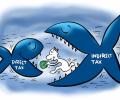
Tax collection so far has been encouraging, with net direct tax receipts reaching Rs 5.21 trillion by June 17, nearly a 15 per cent increase compared to the same period last year.

Like the realisation on the failure of development, we have also internalised the failure on democracy, argues Aakar Patel.

'The West Asia or the Gulf crisis has shown that what we develop as national infrastructure when things are not as bad as they could be, we forget to plan for adversities.'

India has been categorised as one of the 'flawed democracies' in the world and figures 35th in the democracy rankings unveiled in the prestigious magazine The Economist.

The United States, which entered this war in expectation of a short, sharp win along the Venezuela model, is now preparing for deeper involvement in a conflict it does not fully control, without the allies it typically relies on, against an adversary that is not behaving as expected, in a global environment that is already absorbing economic shock. Prem Panicker continues his must read daily blog on the Gulf War.

The ceasefire is still technically holding, to the extent that no overt hostilities have been reported yet, but the rhetoric has hardened dangerously. The week ahead will also clarify whether the Islamabad failure was a negotiating tactic or whether Washington has genuinely locked itself into a position from which the only exits are climb-down, escalation, or the slow bleed of a new status quo that nobody chose and nobody controls. Prem Panicker continues his must read blog on the Iran War.

The intriguing bit is that Trump is likely to attend the talks in Islamabad this weekend -- if he does, it will be the clearest signal yet that the US is ready to exit the war with some sort of win to show, since he cannot afford to go for the talks and return empty-handed, notes Prem Panicker in his must read blog on the Iran War

The 'rescue' operation occurred within kilometres of Iran's underground tunnel complex at Isfahan, assessed by the IAEA and US intelligence as holding a substantial portion of the country's 60 per cent enriched uranium stockpile. Retired senior US military officers have highlighted that the mission's footprint -- hundreds of special operators, multiple heavy-lift aircraft deep inside Iran -- appears outsized for recovering a single airman. Prem Panicker continues his must read blog on the Iran War.

The purge in Washington does not pause the war. Strikes continue, Hormuz remains closed, and Brent crude is still dancing around $109 a barrel. For India, the command chaos in the Pentagon is another layer of uncertainty piled on five weeks of conflict that was already straining every buffer Delhi has.

The core issues to be settled -- access to Hormuz, Israel's aggression in Lebanon, the question of Iran's nuclear programme, sanctions relief and compensation -- are thorny enough to require weeks of patient negotiation. The most likely outcome of the opening sessions is that both sides take the measure of each other, establish what is and is not negotiable, and return home without having broken anything. That would count as progress.

Taking Kharg would give the US control over virtually all of Iran's oil exports and thus provide significant leverage, notes Prem Panicker in his must read daily blog on the Gulf War. It would also put American troops within range of Iran's remaining missiles, drones, and artillery on a piece of real estate that is just eight square miles in size, and just 15 miles from the Iranian mainland.

The delegations from the US and Iran head to Islamabad on Friday, carrying a ceasefire that is already fraying, a Strait that is technically open and practically closed, and a negotiating agenda that would challenge even parties actually negotiating in good faith, which these groups are not. Prem Panicker continues his must read blog on the Iran War.

By all available indications, the White House drafted a face-saving note and handed it, ready-made, to Islamabad. Pakistani Prime Minister Shehbaz Sharif was supposed to then post it in the guise of a plea urging Trump to extend the deadline by two weeks 'to allow diplomacy to run its course'. Trump would then graciously accept Pakistan's 'request' and declare a ceasefire. Sharif dutifully posted the message on X. Except that he, or whoever was handling the account, forgot to delete the tell-tale first line visible in the edit history: 'Draft - Pakistan's PM Message on X'. Prem Panicker's must read blog on the Iran War.

Alliances fight wars effectively only when they share an endgame. If Israel acted without US knowledge, then the military alliance is operating without real coordination at the level of strategic targeting. Neither picture is reassuring in a war that is no longer regional in its consequences. Prem Panicker continues his must read daily blog on the Gulf War.

'The real risk is not that AI will fail to transform India's economy.'
'The risk is that it already is -- while our measurement systems continue to look the other way,' observes Nishant Sahdev, a theoretical physicist at the University of North Carolina.

What we are watching is something different: A fog manufactured and maintained by the people who started the war, so that the question of why it was started never has to be answered, observes Prem Panicker in his must read blog on the war in the Middle East.
Latest report from the Economist Intelligence Unit has ranked world's best cities to live in.
Latest report from the Economist Intelligence Unit has ranked worst cities in the world to live in.

Restoring weighted tax deductions and adopting a petty patents regime can foster firm-level innovative activity critical for competitiveness, points out Nagesh Kumar.
Only few cities have excellent infrastructure, schools, healthcare, etc.

'Are elections still fair in India, or are we all witness to a macabre style of 'selection' of lawmakers? The jury will be out on this for a long time because there is no definitive evidence on either contention, at least as yet,' notes Nilanjan Mukhopadhyay, author, Narendra Modi: The Man, The Times.

More than half (56 per cent) of chief economists expect the global economy to weaken in 2024, with most saying the pace of geo-economic fragmentation will accelerate, according to the latest "Chief Economists Outlook" released on Monday at the World Economic Forum (WEF). The report indicates that the global economic prospects remain subdued and uncertain. Challenges include tight financial conditions, geopolitical rifts, and the rapid development of generative artificial intelligence (AI).

Amid US-China trade tensions and economic vulnerabilities, India must seize the 'China +1' opportunity, deepen reforms, secure FTAs, and globalise its firms for long-term growth, suggests Ajay Shah.

Generative AI is transforming workplaces but at a cost -- there are fewer jobs for young workers just entering the workforce, reveals a Goldman Sachs report.

Auckland in New Zealand has been named the world's most liveable city.
Let's take a look at some of the best and worst cities in the world.
While the world is better fed than it was 50 years ago, those gains are now under threat.
Despite weaker exports and sluggish domestic demand, China is still on track to overtake the United States.

India ranks number one among all countries in respect of both the inflow and outflow of expatriate executives, according to a survey of global firms conducted by leading financial journal The Economist.
Globally, corporate leaders have started pinning high hope on India.
India is expected to be the world's fastest growing economy by 2018.
India's economic growth rate is expected to moderate to 7.8 per cent in 2008-09, mainly on account of a global slowdown, says the Economist Intelligence Unit (EIU), an arm of London-based magazine Economist.Despite moderation in growth, India would continue to remain the second-fastest growing economy in Asia, said senior economist and Asia Editor of the EIU Anjalika Bardalai while briefing reporters ahead of the 13th business round table with government officials.
There are places on earth where petrol is cheaper than water.
According to the first-ever index of security of nuclear materials, India is among the last just above Iran, Pakistan and North Korea.
Check out world's most expensive and cheapest cities.
Organizations operating in multiple geographies, legal environments and cultures face a complex set of challenges and risks as they develop their business.
The inequality between the rich and the poor keeps wages and prices low.
Melbourne is considered to be the most liveable city in the world.
The Asian Green City Index examines the environmental performance of 22 major Asian cities in eight categories: energy and CO2, land use and buildings, transport, waste, water, sanitation, air quality and environmental governance.
